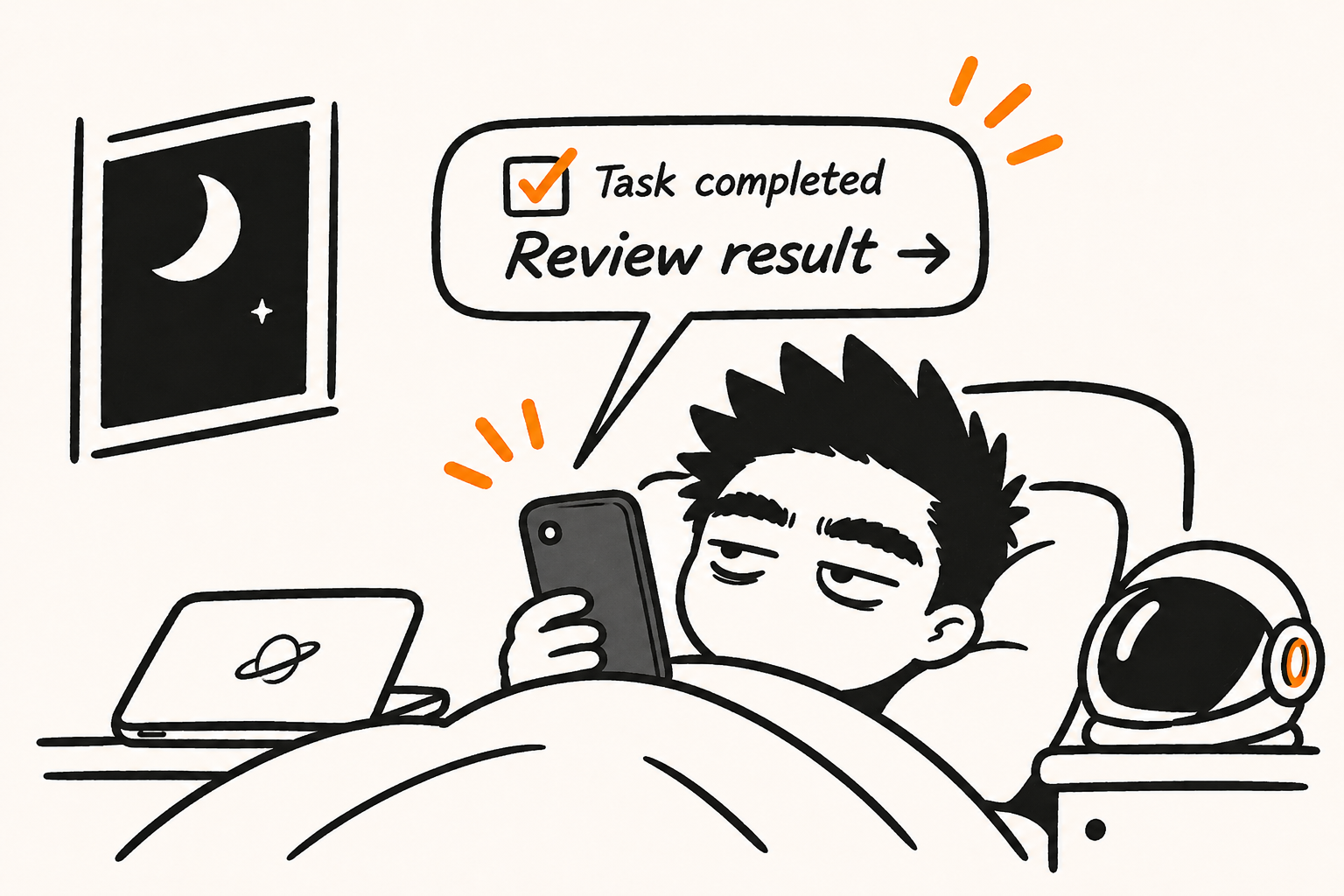
It's midnight. I should be sleeping, but instead, I'm trying to squeeze one last task out of Claude Code.
Apparently, having artificial intelligence do the work wasn't enough. Now I need to make sure it keeps working while I sleep.
Very efficient. Very healthy.
About three years ago, I wanted to build Nimbus, a weather app with a personality of its own. I had the idea, knew how I wanted it to work, and had the design experience. What I didn't have were the technical skills to build it entirely on my own.
Then came Renshi, a project inspired by my Chinese classes and my curiosity about finding a different way to learn the language.
Both projects could easily have ended up in one of those folders full of unfinished ideas. You know the kind. The ones you promise yourself you'll revisit when you have more time, learn another programming language, or find someone willing to build them.
AI changed that.
It didn't give me those ideas. It gave me the ability to finally bring them to life.
And I love that.
When Everything Becomes Possible
There's just one problem: I don't always know when to stop.
I've managed to burn through an entire week's worth of tokens in just two days. Sometimes, before going to bed, I feel the urge to give the model one more task. Not because I actually need it done right then, but for a slightly more dangerous reason: simply because I can.
Recently, I came across the term AI brain fry, which describes the mental fatigue that can come from constantly interacting with and supervising AI tools.
It sounded suspiciously familiar.
In an NPR discussion about research into this phenomenon, they talked about people jumping between different AI tools, constantly reviewing their outputs, and eventually feeling overwhelmed by the sheer amount of work they were managing.
As I listened, I thought, That's exactly what's happening to me.
The funny thing is, building things isn't what exhausts me. I genuinely enjoy it. What's exhausting is deciding what deserves to be built, which features actually matter, what to prioritise, and when something is finally good enough.
Before, the question was whether I could build an idea.
Now, more often than I'd like to admit, the question is why I'm still adding things to it.
AI has lowered the technical barriers to building software. Unfortunately, it hasn't made prioritisation any easier.
Quite the opposite. Now every idea comes with a rather dangerous thought:
Well, I could probably build that too.
And here we go again.
Congratulations, You're the Manager
The irony is that these tools were supposed to make our workloads lighter.
Instead, I often find myself supervising several tasks at once, reviewing generated code, evaluating results, and deciding what the machine should do next.
Without really planning to, I became the manager of my own artificial workforce.
I sometimes jokingly call my AI agents my "little minions". I assign them tasks and leave them working, convinced that I've somehow cracked the secret to productivity.
Except for one tiny detail.
I still have to check what they're doing, approve the permissions they keep requesting, make sure their results actually make sense, and verify that they haven't wandered off to solve an entirely different problem.
Turns out, "letting them work" isn't nearly as relaxing as I imagined.
Apparently, I'm not quite the boss I thought I was.
I call them my little minions, but by the end of the day, I'm the one working for them.
My employees don't need sleep, which sounds wonderful, except their manager seems to have forgotten that he does.
And I've started noticing something even more ridiculous.
I used to feel productive when I finished a task. Now, sometimes, I feel like I'm wasting time if one of my AI agents isn't doing anything.
I could be relaxing, watching a film, or simply doing something else when the thought suddenly crosses my mind: I could have left another feature running in the background.
As though having an idle AI agent were some kind of missed opportunity.
These tools were supposed to free up my time, not make me feel guilty for having any.
But I can't exactly blame them, either.
Claude doesn't show up at midnight demanding that I implement another feature.
I'm the one opening the terminal.
AI simply makes saying yes to another idea far too easy.
And the faster it produces things, the more I have to review. A new feature, another improvement, some secondary idea that suddenly seems worth exploring.
Before I know it, I've got an endless list of tasks that nobody asked me to do.
I don't even have a boss breathing down my neck.
I'm perfectly capable of doing that myself.
The Real Skill Is Knowing When to Close the Laptop
Nimbus still has a few lines of dialogue I need to review. Renshi needs some interface refinements and a basic space for students before I feel comfortable sharing it with more people.
And there's always something else.
A feature that could improve the experience. An interaction that could be more intuitive. Some idea that occurred to me while I was supposed to be working on something entirely different.
As a designer, I've always known that a product doesn't need to be perfect before it's released into the world. Real software rarely is.
The difficult part is applying that same judgement when I can now build almost any improvement that comes to mind.
Before, many ideas were ruled out simply because developing them would take too much effort.
Now I have to reject them for a much less comfortable reason: because they're simply unnecessary.
Recently, I stepped away from intensive coding for a few days. I travelled, spent time talking to people, and took the opportunity to discuss some ideas for Renshi directly with my Chinese teacher.
It was an interesting experience.
I'd spent days thinking about features, adjustments, and possibilities for the project. Yet a single conversation with someone who actually understands the learning experience helped me identify things I hadn't considered and question others that probably weren't needed in the first place.
And I didn't even have to open a terminal.
AI rarely challenges an idea unless I specifically ask it to. I tell it I want to add another feature, and instead of asking whether anyone actually needs it, it starts helping me build it.
Very considerate of it.
Perhaps a little too considerate.
A real person, on the other hand, might ask what something is for, tell me they don't understand it, or suggest a much simpler solution.
What's interesting is that none of this should surprise me.
I've spent years working in UX. I know that design isn't about adding features. It's about understanding problems, questioning decisions, and finding solutions that make sense to people.
But now that I can build my own ideas relatively easily, apparently I need reminding.
AI has allowed me to do things I couldn't do before. I don't want to lose that, let alone stop taking advantage of it.
Still, I'm beginning to realise that being able to build something doesn't necessarily mean I should.
And perhaps that's my own version of AI brain fry: I'm not exhausted because I have to do all the work myself, but because I'm trying to manage everything I suddenly have the power to create.
The answer probably isn't finding another agent, trying a faster model, or figuring out an even more efficient workflow.
Sometimes, it's simply closing the laptop.
Something remarkably straightforward that, for some reason, I'm finding much harder than it should be.
I still need to learn when an idea has received enough attention, when a product is ready for someone else to use, and when a task can wait until tomorrow.
I suppose I could ask Claude to help me organise my priorities.
Although, come to think of it, I'd probably just end up giving it another task.
And it's already midnight.