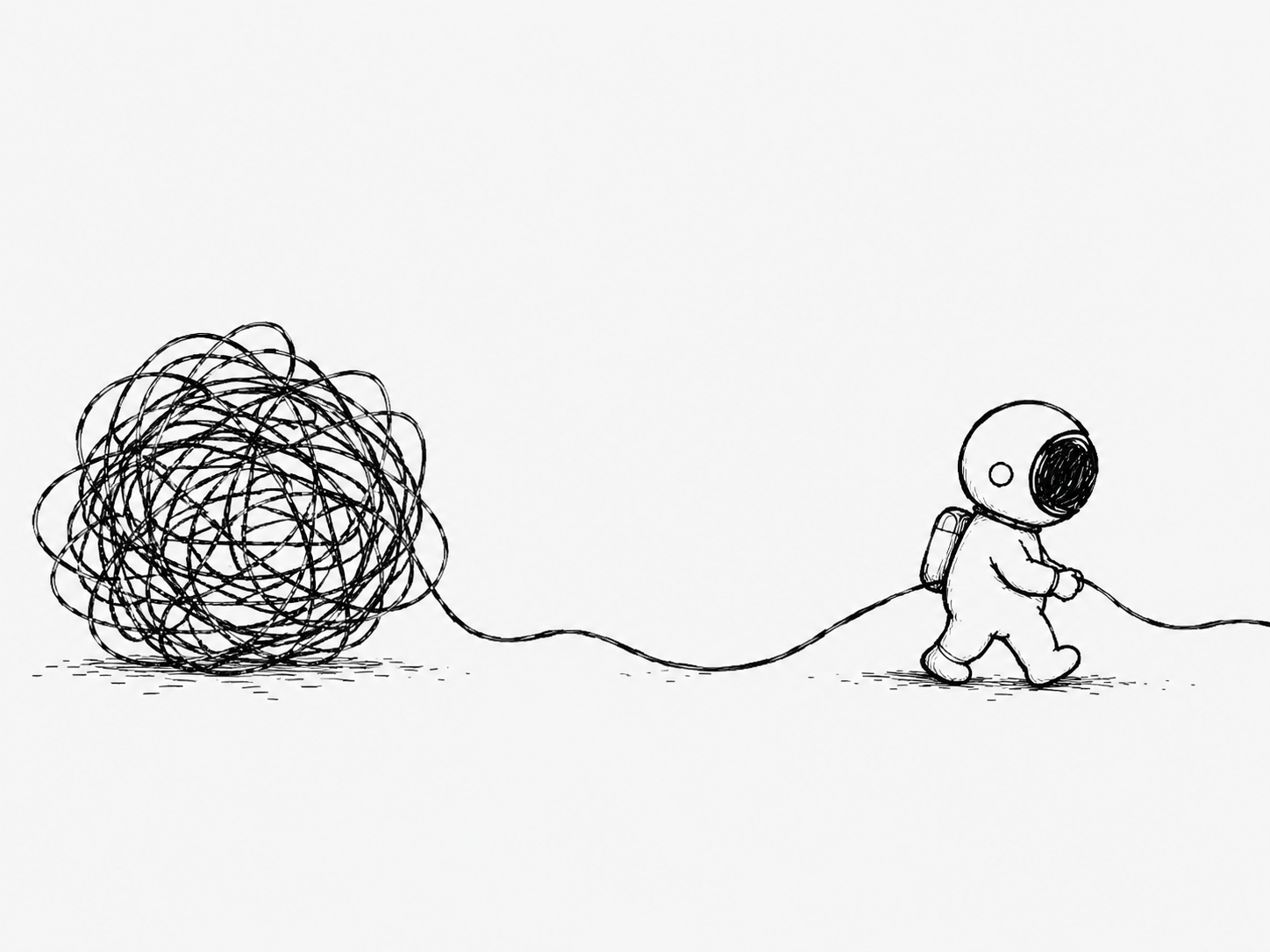
I’m talking about UX because that’s where I experience all of this firsthand, although I suspect this conversation stopped being just ours a while ago.
I’ve had this piece sitting around for a few days. I didn’t publish it sooner because of the classic combination of procrastination and absurd perfectionism. The funny thing is, while I was trying to decide whether to post it, a couple of new models came out that made last week’s debate obsolete—and proved the point I make below.
A few years ago, an absurdly large part of a UX Designer’s job consisted of moving boxes around, drawing ideal flows no user would ever follow, building grayscale wireframes to look strategic, and spending half an hour debating whether that button should really be there.
Today, AI can do most of that before your morning coffee gets cold.
It summarizes interviews, detects patterns, proposes user journeys, generates complete screens, writes frontend code and, just to make things worse, gives you a perfectly polished theoretical explanation of why it made each decision. It is also getting surprisingly good at solving problems we used to swear required “human sensitivity.”
And that brings us to the uncomfortable question nobody really wants to ask:
If the machine can research, structure, design and write... what exactly are we paying you for?(looks at the ceiling and whistles)
The easy way out is to retreat into the moral high ground: “Our value is empathy, judgment, understanding the user’s pain.”
Beautiful slogan for a mug.Not enough.
AI can already imitate many of the signals we associate with empathy surprisingly well, propose reasonable criteria and break down complex systems without getting tired. Desperately looking for “one thing the machine still can’t do” is a fairly fragile strategy. That frontier moves every few months.
And we, or at least I, do not learn that fast.
Let’s not play the victims either. OpenAI or Anthropic did not invent obsolescence.
You start a five-year degree and by the time you reach the tenth semester, some of what you learned in the first one already smells like mothballs. In technology, the joke practically writes itself: you can spend months mastering a tool only to discover, right when you finally get good at it, that another one has appeared and now does half the work for you.
Recently, I tried putting together my professional survival list so I would not become obsolete: Thinking in Systems, Good Services, Continuous Discovery Habits, HAX, PAIR, Service Design, Product Thinking...
An impeccable list. Also an anxiety-inducingly long one.
I could lock myself away for six months devouring books, frameworks and methodologies . The small detail is that by the time I finish the last chapter, the models I started with will already be relics, the market will have invented another trend, and some of the skills I was planning to use as a competitive advantage will probably come built into a text command.
Trying to beat AI in a race of technical skills seems like a terrible bet.
There will always be another framework waiting around the corner.
So maybe the right question is not:
What can I do that AI still can’t?
(That answer expires next Tuesday.)
The real question is, according to research conducted by the University of Nowhere:
What kind of professional do you become when technical skills alone no longer set you apart?
From moving pixels to negotiating reality
Let’s avoid the corporate cliché that UX is moving from “making screens” to “doing strategic work.”
It sounds impressive. It also says almost nothing.
The change is much more concrete.
We are moving from producing artifacts to framing problems, defining criteria, prioritizing real needs, negotiating miserable trade-offs and understanding the system as a whole.
The interface still exists, of course.
It is just no longer the center of the universe, or the boundary of the problem.
Once you lift your head from the design canvas and look at the entire service, reality hits you in the face: broken processes, databases inherited from 2008, absurd corporate policies, legal constraints, operations held together with duct tape, and business exceptions that will never look pretty inside a polished mockup.
That is where the boundaries between roles start dissolving.
And not only because we begin stepping into product or technology territory. Another sacred wall has also fallen: the separation between designing something and building it.
And now, unfortunately, anyone can build
For decades, there was an unspoken agreement. The designer delivered a beautiful prototype and walked away, waiting for some developer to perform the magic required to turn it into reality.
And then blamed them when it did not look exactly the same.
That distance is disappearing.
With code generation tools and the rise of vibe coding, any reasonably competent designer can describe an idea, build a functional prototype and test it with real users without first begging the engineering team for a slot in the backlog.
That is fascinating. It is also potentially dangerous.
Just because we can now build almost anything in minutes does not mean we should.
When building things was expensive and took weeks, technical friction acted as a natural filter against bad ideas.
That filter is disappearing.
Now you can spit out five variations, three alternative flows, two dashboards and an entire app before lunch.
Productivity looks fantastic in a LinkedIn post.
The mess behind what you built, slightly less so.
Then there is the other big risk: ridiculous levels of dispersion.
AI research, AI copy, AI UI, AI prototyping, agents automating other agents. We risk turning ourselves into hyperactive Swiss Army knives with forty tools open at the same time: very busy, very modern, very everything... very nothing.
The cheaper production becomes, the more expensive and scarce good judgment becomes.
An abundance of tools does not replace critical thinking.
It makes it more urgent.
So where should we be heading?
There is no single recipe, and please, for the love of everything sacred, do not update your LinkedIn headline to “Senior AI Human-Centered Ecosystem Strategist.”
Please. Don’t.
But there are a few directions that increasingly make sense:
- Product: to stop designing in a vacuum and understand metrics, financial incentives and real experiments.
- Service Design: to accept that user experience rarely breaks on the screen itself. It usually breaks in logistics, support or internal operations.
- Systems Thinking: to anticipate side effects, dependencies and unintended consequences that no happy path usually shows.
- Architecture and Design Systems: to structure rules, governance and standards that scale beyond whatever visual whim happens to be fashionable this month.
- Human-AI Interaction: to design products where the system no longer just displays information, but interprets, makes decisions and makes mistakes on its own.
- Technical judgment, and some code: not to become a senior developer, but to understand what is actually feasible, work effectively with the machine and avoid designing impossible fantasies.
This is not about collecting certifications like trading cards.
Trying to master everything is probably the perfect recipe for paralysis.
It is about understanding where the value is moving and choosing what kinds of difficult problems you actually want to solve.
For years, we defined our profession by the deliverables we produced: wireframes, interview transcripts, interactive prototypes, components.
A large part of that can now be produced automatically.
Maybe it is time to define our work less by what we draw and more by the decisions we help make: which problems are worth attacking, which features should NOT be built, what ethical or business rules should govern the system, and when technology needs to be stopped before it automates a disaster at scale.